Demineralization (DM) Plant Manufacturer
A DM plant (demineralization plant) removes dissolved salts from water using ion exchange resins, producing high-purity water for boiler feed, laboratories, pharmaceutical manufacturing, electronics rinsing and industrial process applications. Intellect Aqua designs, manufactures and services two-bed, mixed-bed and RO + DM plants across Tamil Nadu.
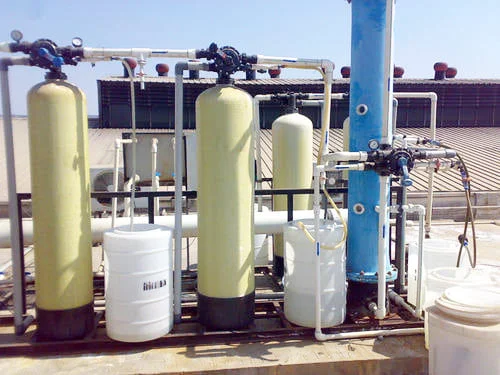
Reliable DM Water Treatment Solutions
DM plants use specialized cation and anion exchange resins to remove dissolved mineral ions from water. The system can be configured according to the required water quality and industrial application.
How a DM Plant Works
A demineralization plant uses ion exchange technology to remove dissolved positive and negative ions from water.
Cation Exchanger
Removes positively charged ions (Ca²⁺, Mg²⁺, Na⁺, Fe²⁺) and replaces them with H⁺ ions using strong acid cation resin.
Anion Exchanger
Removes negatively charged ions (Cl⁻, SO₄²⁻, NO₃⁻, SiO₂) and replaces them with OH⁻ ions using strong base anion resin.
Mixed Bed Polisher (Optional)
Gives ultra-pure water by passing through a mix of cation and anion resin in one vessel.
Regeneration
Resins are regenerated with HCl (acid) for cation and NaOH (caustic) for anion resin when exhausted.
Types of DM Plants
Different DM plant configurations are available to meet varying industrial water purity requirements.
Two-Bed DM Plant
Separate cation and anion columns; suitable for most boiler and process water applications.
Mixed-Bed DM Plant
Single vessel with mixed cation and anion resin; produces ultra-pure, low-conductivity water.
RO + DM System
RO reduces TDS first, DM polishes to final purity; lowers resin regeneration frequency.
Portable DM Unit
Skid-mounted compact unit for small labs and pilot plants.
Features of Our DM Plants
Designed with practical components and monitoring features for industrial water treatment requirements.
Pressure Vessels
FRP or MS pressure vessels — skid-mounted and compact.
Quality Resins
High-capacity cation and anion exchange resins.
Conductivity Monitoring
Online conductivity meter to monitor output quality.
Low Power Consumption
Low power consumption and easy to run.
Compact Installation
Fully skid-mounted — requires less space.
Flexible Capacities
Capacities from 500 LPH to several KLD.
Where DM Water Is Used
Demineralized water is used in industries and facilities that require controlled mineral content and low-conductivity water.
DM Plant or RO? Which Do You Need?
Both remove dissolved salts but work differently:
RO Plant
Good for general drinking water and process water with moderate purity needs. No chemicals for operation.
DM Plant
Needed for boilers, pharma and labs where conductivity must be very low (<10 µS/cm). Requires acid and caustic for regeneration.
RO + DM
Best for high-TDS borewell water where both water saving and ultra purity are required.
What Decides the DM Plant Price?
The cost of a DM plant depends on raw water characteristics, required output quality and system configuration.